In January 2019, a tailings dam at Vale’s Córrego do Feijão mine in Brumadinho, Brazil collapsed without warning. It killed 270 people and triggered reparation costs exceeding $7 billion (Vale Corporate Disclosures, 2024). Investigators found that inadequate material testing of the dam’s embankment soils played a direct role in the failure.
That disaster wasn’t an anomaly. Researchers have documented 287 tailings dam failures worldwide since 1960, averaging 4.4 per year—and the frequency keeps climbing (ScienceDirect, 2022). Every one of those failures represents a gap between what material testing could have caught and what operators chose to overlook.
So how exactly does material testing protect the mining industry? What methods matter most, and what’s the real cost of skipping them? This article breaks it down—from laboratory rock mechanics to non-destructive wire rope inspection—with the data to back it up.
Key Takeaways
- 287 tailings dam failures documented since 1960, with 39% occurring in the United States (U.S. National Park Service, 2013).
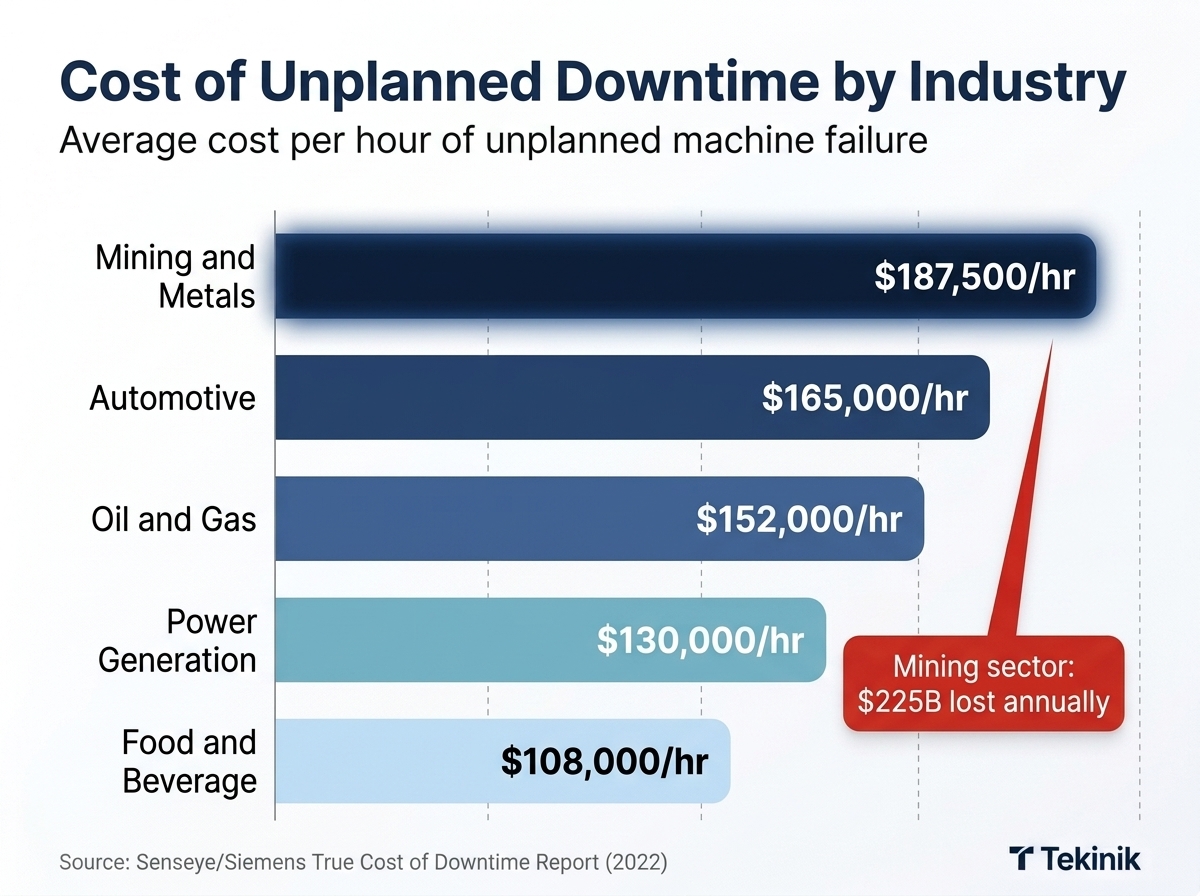
- Mining companies lose an average of $187,500 per hour to unplanned downtime from equipment and structural failures (Senseye/Siemens, 2022).
- The global NDT market is projected to grow from $18.8 billion to $42.3 billion by 2034, driven heavily by mining and heavy industry (Fortune Business Insights, 2025).
- Rigorous laboratory testing—hardness, uniaxial compression, point load index—remains the gold standard for predicting rock behavior under operational stress.
What Types of Material Testing Are Used in Mining?
Mining operations rely on precise mechanical data to prevent structural failures. ASTM D7012-23 provides the standard test methods for compressive strength and elastic moduli of intact rock core specimens, while the International Society for Rock Mechanics (ISRM) has compiled suggested methods spanning 1974–2006 that cover everything from rock characterization to long-term monitoring (ISRM/Springer Nature, 2025).
The core laboratory techniques break down into three categories:
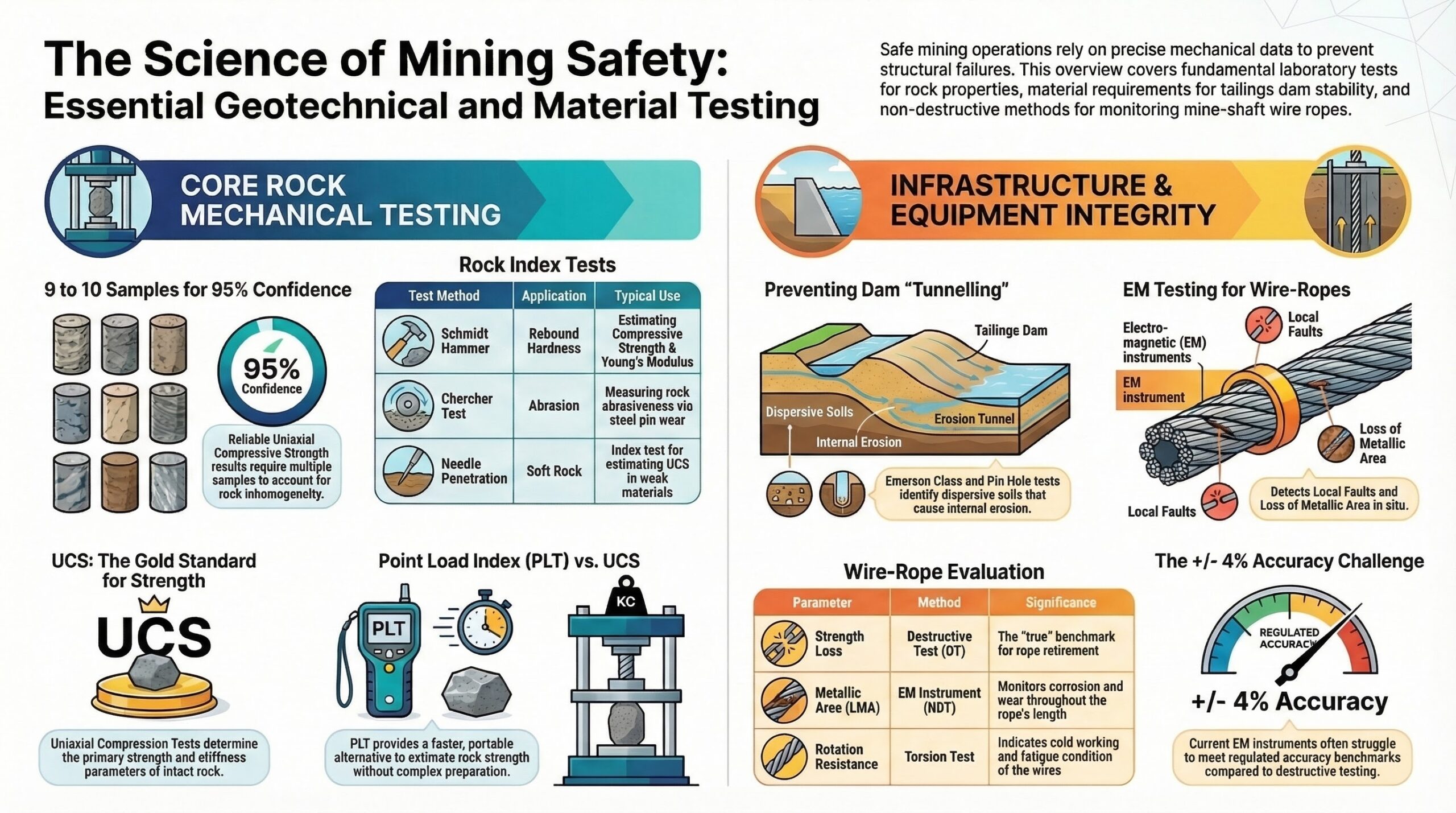
Hardness and abrasion tests measure a rock’s resistance to surface wear. Schmidt Hammer rebound tests, Cerchar abrasivity testing, and Mohs hardness assessments tell engineers how quickly drill bits will degrade and whether tunnel linings can withstand long-term contact with surrounding geology.
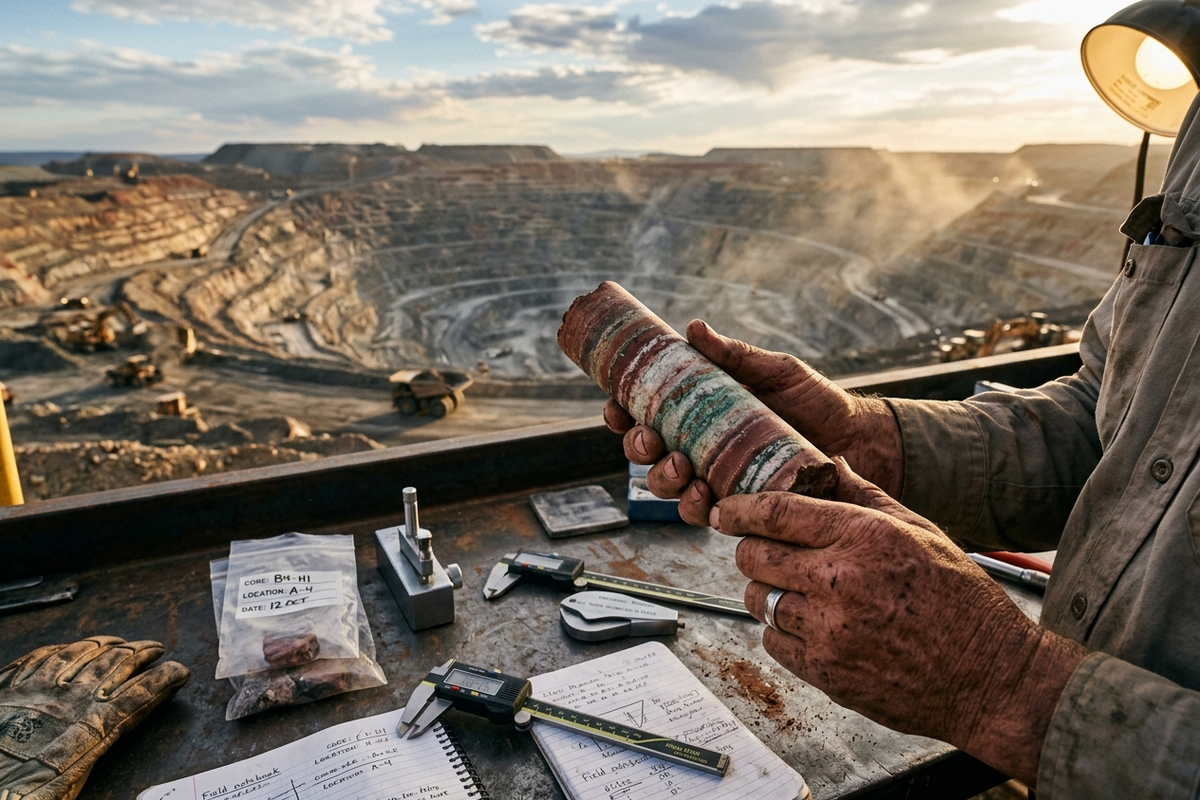
Uniaxial compression strength (UCS) is considered the gold standard for rock strength. A cylindrical core sample gets compressed until it fractures, revealing the maximum stress a rock formation can handle. Reliable UCS results typically require 9 to 10 samples for 95% confidence, since rock is naturally heterogeneous.
Point load index (PLI) testing offers a faster, more portable alternative. Instead of requiring a full laboratory press, PLI uses a compact device that can be deployed at the drill site. It provides a reasonable estimate of rock strength that correlates with UCS, making it especially useful for preliminary assessments of complex rock formations.
The Science of Mining Safety: Essential Geotechnical and Material Testing
Beyond rock mechanics, material testing extends to every structural component in a mine—steel supports, concrete linings, conveyor belt materials, and the soils used in embankment construction. Each requires its own testing protocol tailored to the specific failure mode engineers need to prevent.
How Does Material Testing Prevent Tailings Dam Failures?
Tailings dams are among the most dangerous structures in mining. Researchers have documented 287 failures worldwide since 1960, and 39% of those occurred in the United States alone (U.S. National Park Service, 2013). The failure rate isn’t slowing down—it’s averaging 4.4 incidents per year over the last seven decades, with a gradual upward trend (ScienceDirect, 2022).
What causes these failures? In most cases, the embankment materials themselves. Tailings dams aren’t built with engineered concrete—they’re constructed from the mine’s own waste material, compacted soil, and local fill. If the soil is dispersive (prone to eroding from within when exposed to water), the entire structure can unravel through internal piping.
Two tests are critical here:
Soil dispersion testing identifies whether embankment clays will dissolve and erode when they contact water. The Emerson Crumb test and pinhole test are standard methods. A dispersive clay that goes undetected can create internal erosion channels that cause catastrophic breaches—exactly the failure mode behind many of the 287 documented incidents.
Permeability testing measures how fast water moves through the dam’s materials. If permeability is too high, seepage pressures build up inside the embankment. If it’s too low in the wrong zones, pore water pressure accumulates with no drainage path. Both conditions lead to slope instability.
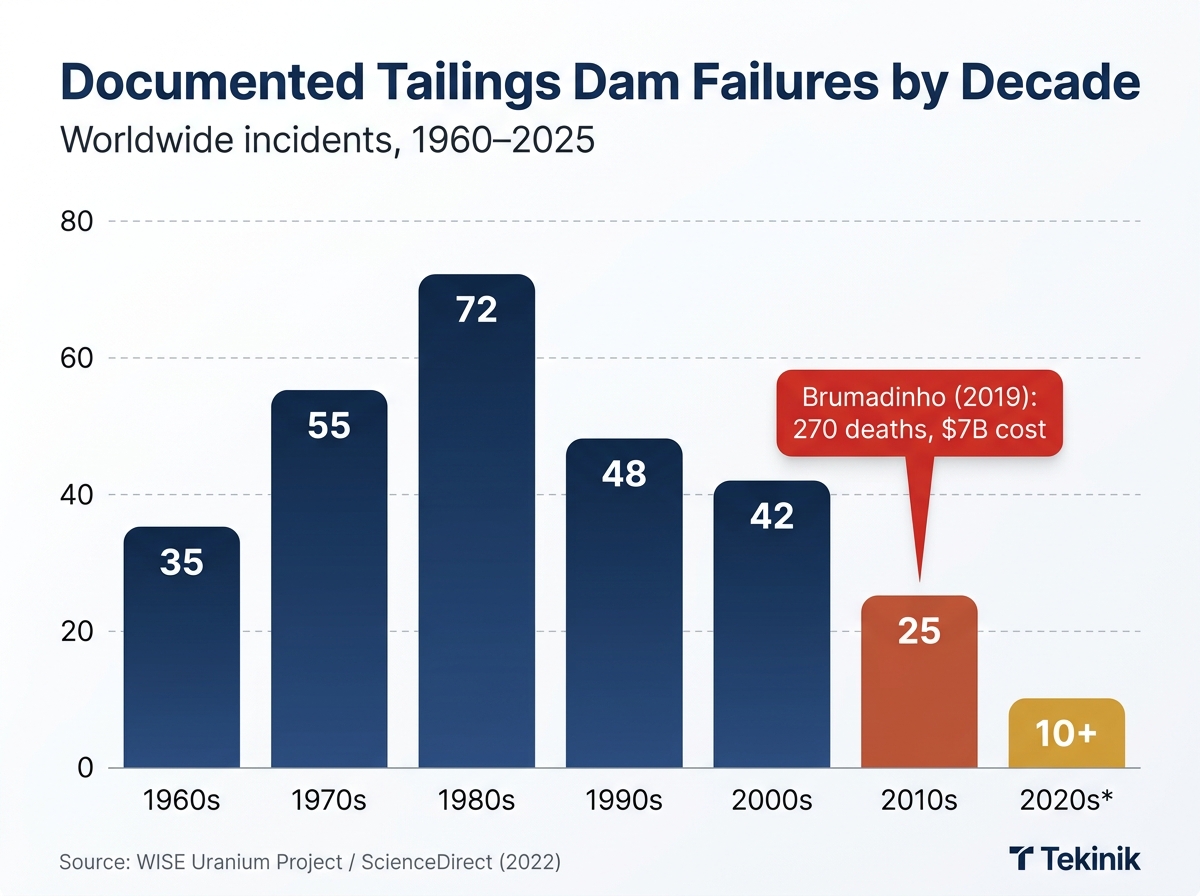
Consider the 1998 Los Frailes tailings dam failure in Spain: it released 528 million gallons of pyrite sludge and over 1 billion gallons of contaminated acid water across 38.5 miles of river. Cleanup costs exceeded $225 million (U.S. National Park Service, 2013). Proper soil dispersion and permeability testing of the embankment materials could have flagged the structural weakness before it became a catastrophe.
What Role Does Non-Destructive Testing Play in Mine Safety?
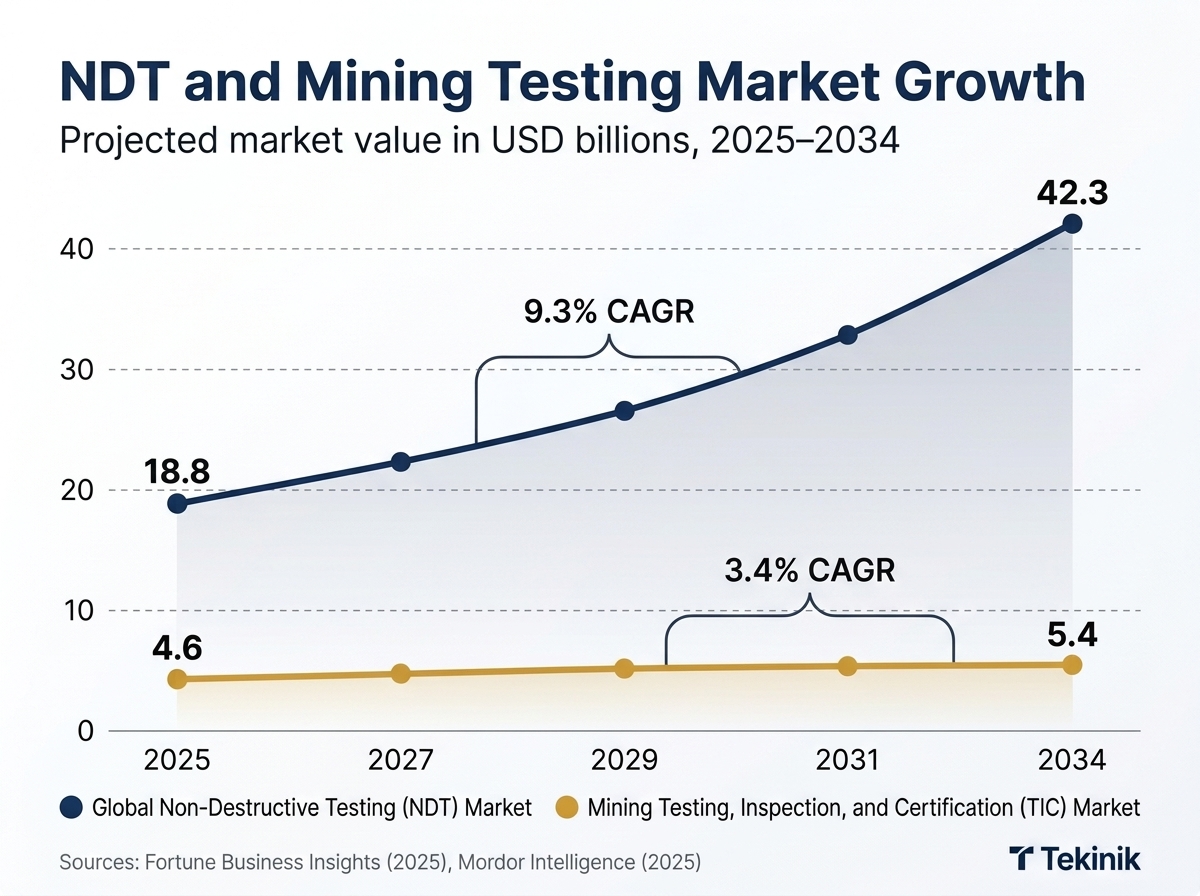
The global non-destructive testing (NDT) market reached $18.8 billion in 2025 and is projected to hit $42.3 billion by 2034—a 9.3% compound annual growth rate driven significantly by mining and heavy industry demand (Fortune Business Insights, 2025). That growth reflects an industry-wide recognition that you don’t always need to destroy a component to understand its condition.
In mining, one of the most critical NDT applications is electromagnetic examination of mine-shaft wire ropes. These ropes carry personnel and ore through vertical shafts that can extend thousands of feet underground. A single rope failure can be fatal.
Electromagnetic testing works by passing the wire rope through a magnetic field. Sensors detect variations in the magnetic flux that indicate broken wires, corrosion, or internal wear—defects that are invisible during a visual inspection. The technology can identify hazardous strength losses before they reach the point of failure.
But there’s a catch. Current electromagnetic inspection instruments often struggle to achieve accuracy better than ±4%. That might sound acceptable until you consider that a 4% error margin on a rope rated for 100 tons means the actual breaking strength could be anywhere from 96 to 104 tons. For an operation running near the rope’s rated capacity, that uncertainty becomes a serious safety question.
This accuracy challenge is driving international collaboration on testing standards. Researchers from multiple countries have published collaborative reports evaluating how to improve electromagnetic examination methods—comparing localized fault detection with overall cross-sectional loss measurement, and developing calibration protocols that reduce the margin of error.
Beyond wire ropes, NDT methods used across mining operations include:
- Ultrasonic testing — detects internal flaws in steel supports, bolts, and structural members
- Magnetic particle inspection — reveals surface and near-surface cracks in ferromagnetic components
- Radiographic testing — provides internal imaging of welds and castings in heavy equipment
- Acoustic emission monitoring — listens for stress signals in rock formations to predict collapses
What Is the Economic Impact of Skipping Material Testing?
Mining, metals, and heavy-industrial companies lose an average of $187,500 per hour to unplanned downtime, according to a Senseye study of Fortune Global 500 manufacturers. Across the sector, that adds up to $225 billion annually and 1.2 million unplanned downtime hours per year (Senseye/Siemens, 2022).
Much of that downtime traces back to material failures that testing could have predicted. A conveyor belt splice that fails because the rubber compound wasn’t tested for heat resistance. A roof bolt that fractures because the steel batch had an undetected metallurgical defect. A pump casing that cracks because nobody checked whether the alloy was compatible with the slurry chemistry.
The regulatory cost is climbing too. Since 2023, MSHA impact inspections have identified 5,246 violations across more than 300 mines, including 1,456 significant and substantial violations and 102 unwarrantable failure findings (U.S. Department of Labor, 2024). Each violation carries fines, potential shutdowns, and legal liability. The cost of material testing is a fraction of the cost of a single serious violation—let alone a catastrophic failure.
Top mining companies seem to agree. The eight largest global mining majors more than doubled their capital spending from $23.9 billion in 2017 to $48.4 billion in 2024, with a significant portion directed toward safety infrastructure and testing capabilities (Engineering & Mining Journal, 2025).
Which Standards Govern Mining Material Testing?
Mining material testing isn’t a free-for-all—it operates within a framework of international standards that define exactly how tests should be performed, calibrated, and reported. Getting the standards wrong means getting the results wrong, regardless of how sophisticated the equipment.
The two primary standards bodies are:
ASTM International publishes the benchmark specifications. ASTM D7012-23 covers compressive strength and elastic moduli for rock core specimens. ASTM D4543 specifies how to prepare those specimens—dimensions, end-face flatness, moisture conditioning. ASTM D5731 governs point load index testing. These aren’t suggestions; they’re the protocols that laboratory accreditation depends on.
ISRM (International Society for Rock Mechanics) supplements ASTM with suggested methods developed through decades of international collaboration. Their compilation covers rock characterization, testing, and monitoring from 1974 through 2006, with ongoing updates. Where ASTM provides the procedural rigor, ISRM provides the interpretive framework that helps engineers understand what the numbers actually mean in geological context.
For tailings dams specifically, the Global Industry Standard on Tailings Management (GISTM)—developed after the Brumadinho disaster—now requires independent technical review of dam designs and ongoing material testing throughout a dam’s lifecycle. It’s not yet legally binding everywhere, but major mining companies have committed to compliance, and insurers increasingly require it.
MSHA’s regulatory inspections add an enforcement layer. With 33 mining fatalities reported in 2025—an 18% increase from 28 in 2024—the agency has intensified its inspection regime, particularly at construction-materials locations where 19 of those fatalities occurred (North American Mining, 2026).
How Is Technology Changing Material Testing in Mining?
The mine safety monitoring system market reached $1.85 billion in 2024 and is projected to nearly double to $3.58 billion by 2032, growing at 8.2% annually. Hardware components—sensors, data acquisition units, monitoring instruments—dominate at 55.3% market share (Future Market Report, 2024).
What’s driving that growth? Three converging technologies:
IoT-enabled continuous monitoring replaces periodic manual inspections with real-time data streams. Strain gauges embedded in support structures, vibration sensors on rotating equipment, and moisture sensors in tailings dam embankments all feed data back to central monitoring platforms. Instead of testing a wire rope once a month, you’re monitoring its condition every second.
AI-driven predictive analytics turn that continuous data into actionable forecasts. Machine learning models trained on historical failure data can identify degradation patterns weeks or months before they reach critical thresholds. A gradually increasing vibration signature in a ball mill, for instance, might indicate bearing wear that’s invisible to scheduled inspections but obvious to a pattern-recognition algorithm.
Digital twin simulation creates virtual replicas of physical structures—tailings dams, underground excavations, processing plants—that can be stress-tested with real-time material data. When new test results come in for a rock formation’s compressive strength, the digital twin updates its structural model and flags any zones where the safety factor has dropped below acceptable levels.
These technologies don’t replace fundamental material testing—they extend it. You still need to know the UCS of a rock formation. But now you can combine that laboratory measurement with continuous field monitoring to build a much more complete picture of structural integrity over time.
The mining testing, inspection, and certification (TIC) market reflects this evolution: valued at $4.56 billion in 2025 with testing services holding 52.4% market share, the sector is growing steadily toward $5.38 billion by 2030 (Mordor Intelligence, 2025).
Frequently Asked Questions
What is uniaxial compression strength testing in mining?
Uniaxial compression strength (UCS) testing compresses a cylindrical rock core specimen until it fractures, measuring the maximum stress the rock can withstand. It’s considered the gold standard for rock strength assessment. Reliable results typically require 9 to 10 samples for 95% statistical confidence due to natural rock heterogeneity (ISRM/Springer Nature, 2025).
How often do tailings dams fail worldwide?
Tailings dam failures have averaged 4.4 incidents per year from 1947 through 2021, with 287 total failures documented since 1960. The frequency has been gradually increasing over time, and 39% of all global failures have occurred in the United States (ScienceDirect, 2022).
What does non-destructive testing mean for mine safety?
Non-destructive testing (NDT) evaluates the integrity of materials and structures without damaging them. In mining, this includes electromagnetic examination of wire ropes, ultrasonic testing of steel supports, and acoustic emission monitoring of rock formations. The global NDT market is valued at $18.8 billion and growing at 9.3% annually (Fortune Business Insights, 2025).
How much does mining downtime cost?
Mining and metals companies lose an average of $187,500 per hour to unplanned downtime, totaling approximately $225 billion annually across the sector. That figure comes from 23 hours of monthly machine failures and 1.2 million unplanned downtime hours per year across Fortune Global 500 industrial companies (Senseye/Siemens, 2022).
What standards govern rock testing in mining?
ASTM D7012-23 is the primary standard for compressive strength and elastic moduli of intact rock core specimens. The International Society for Rock Mechanics (ISRM) supplements this with suggested methods for rock characterization, testing, and monitoring compiled from 1974 through 2006. MSHA enforces compliance through inspections—identifying 5,246 violations since 2023 (U.S. DOL, 2024).
The Bottom Line
Material testing isn’t overhead—it’s infrastructure protection. Every dollar spent on hardness tests, uniaxial compression analysis, soil permeability evaluation, and wire rope electromagnetic examination is a dollar that prevents the kind of catastrophic failures that cost lives and billions in damages.
The data makes the case clearly: 287 tailings dam failures, $225 billion in annual downtime losses, 33 mining fatalities in 2025 alone. These aren’t abstract risks. They’re the direct, measurable consequences of inadequate testing.
The mining industry is investing accordingly—doubling capital spending in seven years, expanding non-destructive testing programs, and integrating real-time monitoring with laboratory analysis. The companies that treat material testing as a core operational discipline, not a regulatory checkbox, are the ones that avoid becoming the next case study in preventable failure.
Sources:
[1] Vale Corporate Disclosures / Wikipedia, Brumadinho Dam Disaster. wikipedia.org
[2] ScienceDirect, Tailings Dam Failure Statistics and Trends. sciencedirect.com
[3] U.S. National Park Service, Long-term Risk of Tailings Dam Failure. nps.gov
[4] Senseye/Siemens, The True Cost of Downtime (2022). siemens.com
[5] Fortune Business Insights, Non-Destructive Testing (NDT) Market (2025). fortunebusinessinsights.com
[6] Mordor Intelligence, Mining Testing, Inspection and Certification Market (2025). mordorintelligence.com
[7] U.S. Department of Labor / MSHA, Impact Inspections Results (2024). dol.gov
[8] North American Mining, MSHA Reported 33 Fatalities in 2025. northamericanmining.com
[9] Engineering & Mining Journal, 2025 Global Mining Project Spending Outlook. e-mj.com
[10] ISRM / Springer Nature, Suggested Methods for Rock Characterization (2025). springer.com
[11] Future Market Report, Mine Safety Monitoring System Market (2024). futuremarketreport.com
[12] ASTM International, ASTM D7012-23: Standard Test Methods for Compressive Strength. astm.org